Why Your Soakaway Isn't Draining: Common Causes and No-Dig Solutions
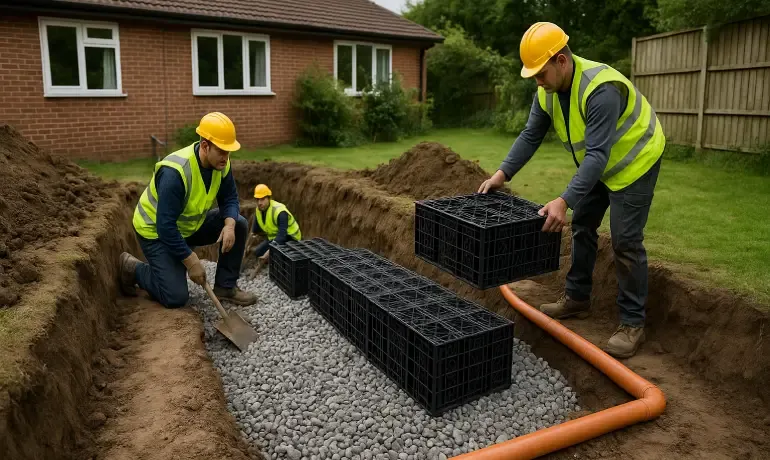
A failing soakaway can lead to waterlogged gardens and property risks. We explore the common causes of failure and the trenchless repair methods that restore drainage without major excavation.
Understanding Soakaway Failure
A soakaway is a crucial component for managing surface water and wastewater from properties not connected to a main sewer. When it stops draining effectively, water begins to pool, often saturating your garden and potentially risking structural damage to your property. The failure is rarely sudden; it's typically the result of a gradual process where the system's capacity to disperse water into the surrounding subsoil is compromised. From our experience, the root causes generally fall into a few specific categories, all of which can be diagnosed and often resolved without resorting to extensive, disruptive digging.
Common Causes of a Blocked or Failed Soakaway
The most frequent issue we encounter is silt and sediment infiltration. Over years, fine particles wash into the soakaway chamber or perforated pipes, gradually clogging the voids in the surrounding rubble and the soil itself. This dramatically reduces the permeability of the system. Another prevalent cause is root ingress from nearby trees and shrubs. Roots seek out moisture and can aggressively invade pipes and chambers, causing physical blockages and structural damage. In older properties, the original construction might simply be inadequate for current demands, having degraded or been overwhelmed by increased surface water from patios or extensions.
Sometimes, the problem is external. A high water table or a change in the surrounding soil composition, perhaps due to building work nearby, can prevent water from percolating away. It's also possible for the outlet pipe connecting the property to the soakaway to collapse or become blocked independently, mimicking a soakaway failure. Precise diagnosis is key, which is why our engineers use advanced CCTV drain surveys to inspect the entire run and the soakaway chamber visually, identifying the exact point and nature of the failure without any guesswork or unnecessary excavation.
Trenchless Solutions for Soakaway Problems
Once the cause is identified, our focus is on implementing the least disruptive solution. For a silted-up soakaway, high-pressure jetting can often clear the internal chamber and connecting pipework, restoring some flow. However, if the surrounding soil is compacted, a more robust repair is needed. This is where our no-dig expertise comes to the fore.
We frequently employ CIPP (Cured-In-Place Pipe) lining technology. This process involves inserting a resin-saturated felt liner into the existing pipe leading to the soakaway. It is then inflated and cured, forming a seamless, jointless new pipe within the old one. This not only seals cracks and blocks root ingress but also improves flow. For a completely collapsed section, pipe bursting—a method where a new pipe is pulled through while simultaneously fracturing the old one—can be a trenchless alternative.
In cases where the soakaway chamber itself has failed, excavation might be discussed, but we first assess all options for localised repair or replacement of the inflow pipe to maximise the existing system's life. Our approach is always to minimise surface disruption, preserve your landscaping, and provide a durable repair that addresses the core issue, not just the symptom.
If you're experiencing persistent pooling water, it's advisable to act promptly. Early intervention with a CCTV survey can identify a simple blockage, while leaving the issue can lead to more extensive—and expensive—subsoil failure. Our engineers provide clear, precise advice on the most effective and least invasive path to restoring your property's drainage.
Frequently asked questions
Can a blocked soakaway be repaired without digging up my entire garden?
Yes, in many cases. Using CCTV surveys for precise diagnosis, we often resolve issues via high-pressure jetting or trenchless pipe relining (CIPP). These methods repair the pipes leading to the soakaway internally, eliminating the need for large-scale excavation unless the chamber itself has completely collapsed.
What is CIPP lining and how does it help a failing soakaway?
CIPP (Cured-In-Place Pipe) lining is a no-dig technique where we insert a resin-coated liner into the existing pipe. Once cured, it forms a tough, seamless new pipe inside the old one. This seals cracks, prevents root intrusion, and restores flow to the soakaway, all without the disruption of traditional digging.
How do you find out what's wrong with my soakaway if it's buried?
We use a small, high-resolution CCTV camera mounted on a flexible rod. This is fed through the drainage pipes, providing a live video feed that allows our engineers to visually inspect the entire system, identify blockages, root ingress, or structural damage, and pinpoint the exact cause of the failure.